July 7, 2024
By R. Michael Brown, Future Vision Technology Writer & Producer*
The rapid pace of technological advancement continues to shape our daily lives, introducing new possibilities and transforming the way we interact with the world. Several consumer technology trends are expected to make a significant impact over the next two years.
Why Just Two Years?
Why just the next two years and not five, ten, or longer? After working on future trends at IBM [multimedia and Internet for consumers], Motorola [wireless technology and business and government systems], Town of Palm Beach [government-citizen technology projections], and Pulte Homes and My State MLS real estate trends – I’ve found that today, longer than two years is way too hard to predict with any confidence.
Tech evolution is accelerating.
For example, in 2022 at My State MLS, the only nationwide multiple listing service software, we were exploring the near-term future of Augmented (AR) and Virtual Reality (VR), and Blockchain and Crypto Currency, and how the tech would impact the real estate market for buyers, sellers, brokers, and agents. We thought those technologies were going to be the top trends to impact the United States. Then in November 2022, ChatGBT and Artificial Intelligence (AI) soared to the front and our top three or four explorations got lost in the AI explosion.
AI is such a game changer that most other technologies are depending on its use and integration. And, the entrepreneurial spirit of US technologists and business leaders are charging at it hard.
Here are the top trends to watch, along with expert insights and background information.
Artificial Intelligence and Machine Learning

AI and machine learning (ML) are set to become even more integral to consumer technology. These technologies are supercharging many applications, from virtual assistants to personalized recommendations, from building new software to creating websites, and more in these industries:
Healthcare: AI is used for diagnosing diseases, predicting patient outcomes, personalizing treatment plans, and managing patient data. It also aids in drug discovery and development.
Finance: AI helps in fraud detection, risk management, algorithmic trading, and providing personalized financial advice through robo-advisors.
Retail: AI enhances customer experience through personalized recommendations, inventory management, and optimizing supply chain operations. It also powers chatbots for customer service.
Transportation: AI is crucial in developing autonomous vehicles, optimizing traffic management systems, and improving logistics and delivery services.
Manufacturing: AI is used for predictive maintenance, quality control, supply chain optimization, and automating routine tasks in production lines.
Education: AI provides personalized learning experiences, automates administrative tasks, and offers intelligent tutoring systems that adapt to student needs.
Entertainment: AI helps in content recommendation, game development, and creating realistic animations and special effects.
Customer Service: AI-driven chatbots and virtual assistants handle customer inquiries, provide support, and enhance user engagement.
Marketing: AI is used for customer segmentation, sentiment analysis, targeted advertising, and optimizing marketing campaigns.
Content Creation: AI is being used to brainstorm ideas for content; generate articles and reports; edit and proofread; create images, video, and sound; personalize content dynamically; automate transcription and translation; and more… Stay tuned for a future article on this topic.
Energy: AI optimizes energy usage, predicts equipment failures, and manages smart grids to improve energy efficiency and sustainability.
Security: AI enhances cybersecurity by detecting anomalies, preventing cyberattacks, and analyzing security threats in real-time.
Human Resources: AI streamlines recruitment processes, analyzes employee performance, and improves talent management through predictive analytics.
According to Gartner, “By 2025, AI will be embedded in 95% of customer interactions with enterprises.”
AI’s ability to analyze vast amounts of data quickly and accurately is revolutionizing industries, making devices smarter and more responsive to user needs.
“AI and ML are transforming consumer technology by enabling more personalized, efficient, and seamless experiences.” said Bernard Marr, a renowned futurist. “As these technologies advance, we can expect even greater integration into our everyday devices.”
Brain Computer Interfaces
By 2025, brain-computer interfaces (BCIs) are expected to make significant strides, transforming how humans interact with technology. BCIs enable direct communication between the brain and external devices, allowing for seamless control of computers, prosthetics, and other technologies through thought alone. This innovation promises to revolutionize fields such as healthcare, gaming, and communication.
Accordingly, Elon Musk’s company, Neuralink, is at the forefront of BCI development. Musk envisions a future where BCIs enhance human capabilities and improve quality of life. He stated, “With a high bandwidth, brain-machine interface, I think we can actually go along for the ride and effectively have the option of merging with AI.”
Musk said that Neuralink’s first product is called “Telepathy,” which will enable users to control their phones or computers “just by thinking.” He added that these early users would be those who have lost use of their limbs.
In healthcare, BCIs hold potential for treating neurological disorders, enabling paralyzed individuals to control prosthetic limbs, and restoring lost senses. In the gaming and virtual reality sectors, BCIs could offer unprecedented immersive experiences, controlled entirely by the mind.
According to Market Growth Research the global Brain Computer Interface market was valued at USD 196.9 million in 2023 and is anticipated to reach USD 460.1 million by 2030, witnessing a CAGR of 12.4% during the forecast period 2024-2030. Not a huge dollar amount but a remarkable and unquantifiable aid to those in need.
Quantum Computing
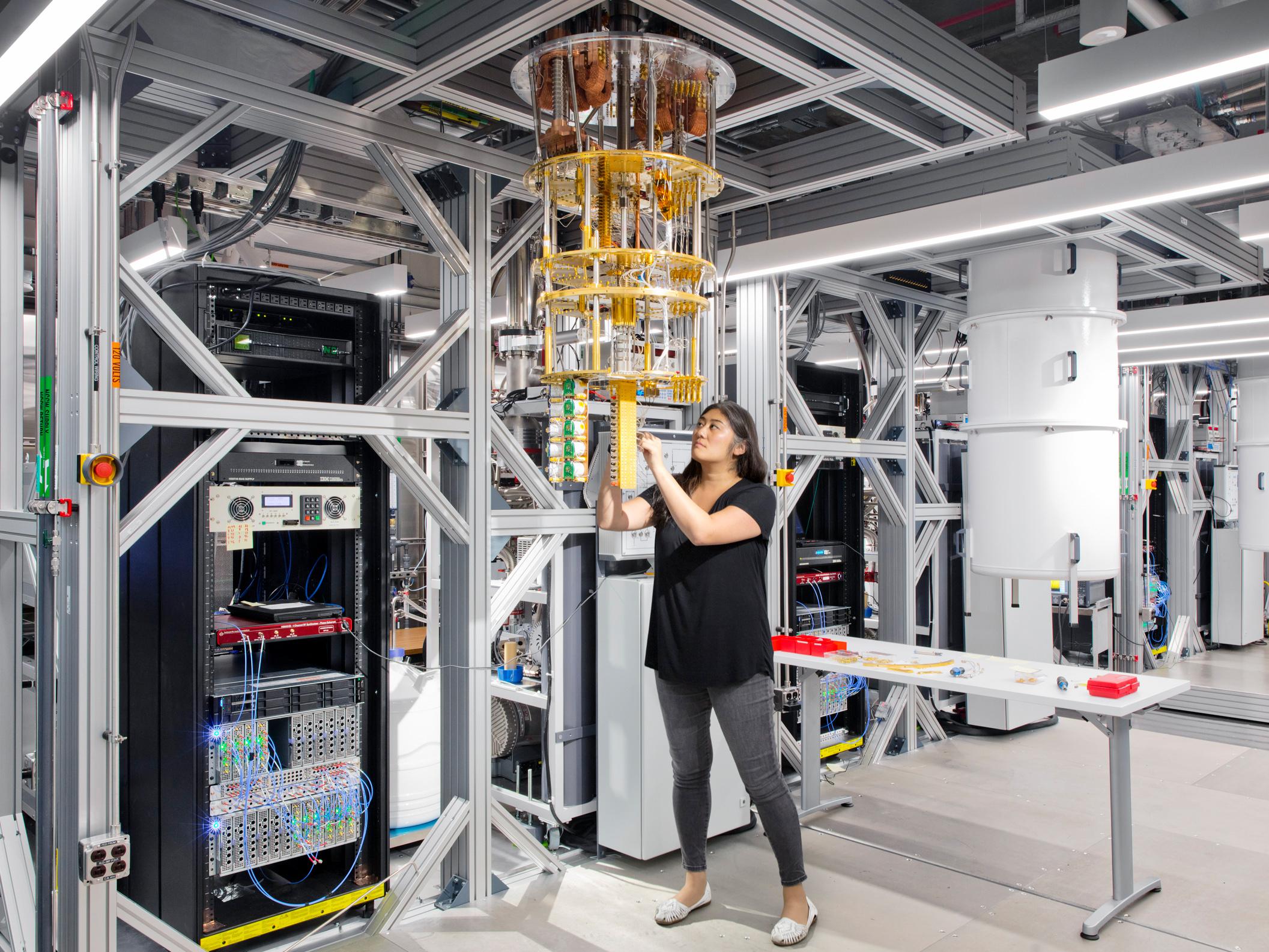
Quantum computing is expected to revolutionize industries such as cryptography, drug discovery, and financial modeling. Quantum computers use the principles of quantum mechanics to perform complex calculations at unprecedented speeds, far surpassing the capabilities of classical computers.
IBM is a significant player in this field, with its IBM Q initiative striving to make quantum computing accessible for commercial and research applications. IBM’s roadmap aims for systems with over 1,000 qubits, dramatically boosting computational power. Other major players include Google, with its Sycamore processor, and Microsoft, focusing on topological qubits.
Dr. John Preskill, a theoretical physicist at Caltech, says, “Quantum computing will enable us to solve certain problems exponentially faster than classical computers, potentially transforming entire sectors of the economy.”
Quantum computing is set to become a critical technology driving advancements across various domains by 2025 as these companies continue to innovate.
For that reason Hyperion Research expects the market to reach $1.5 billion by 2026
Augmented Reality and Virtual Reality

Augmented reality and virtual reality are no longer confined to gaming and entertainment. These immersive technologies are expanding into education, healthcare, and retail. AR enhances the real world with digital overlays, while VR provides fully immersive virtual environments.
According to Statista, the AR and VR market is projected to reach nearly $300 billion by 2024.
Tom Emrich, a leading AR/VR expert, explains, “The future of AR and VR lies in their ability to create immersive, engaging experiences that bridge the gap between the physical and digital worlds. These technologies will revolutionize how we learn, shop, and interact.”
5G Connectivity

The rollout of 5G networks is accelerating, promising faster speeds, lower latency, and improved connection. This next-generation network will enable a host of new applications, from real-time streaming to enhanced Internet of Things (IoT) capabilities.
Ericsson predicts there will be 3.5 billion 5G subscriptions globally by 2026.
“5G will unlock unprecedented opportunities across industries, providing the foundation for a new era of connectivity, said Cristiano Amon, CEO of Qualcomm. “It will enable smarter cities, autonomous vehicles, and more connected lives.”
Smart Home Technology

Smart home devices are becoming more sophisticated and interconnected, driven by advancements in AI and IoT. From smart thermostats to security systems and voice-controlled assistants, these technologies enhance home automation and energy efficiency. Markets and Markets estimates that the global smart home market will reach $135.3 billion by 2025.
In our 2006 lake house that we just bought in Lake Placid, Florida last year, the air conditioning and appliances were all upgraded with LG smart tech. I can control the A/C, refrigerator, dishwasher, TV, and Bose sound systems from my phone. In addition, we added Ring lights, doorbell, and cameras around our 1.2 acres and our security is all managed from our iPhones. We had a trespasser on our property when we were out of town and the police and neighbors helped identify him within minutes. We had the video evidence to show the police and case closed.
Stacey Higginbotham, a smart home technology journalist, states, “The smart home of the future will be more intuitive and integrated, offering seamless control over various aspects of daily life. This will lead to greater convenience, security, and energy savings.”
Wearable Technology

Wearable devices are evolving beyond fitness trackers to include comprehensive health monitoring and smart features. Innovations in sensor technology and AI are enabling wearables to track vital signs, detect anomalies, and even predict health issues.
Indeed Allied Market Research forecasts the global wearable technology market will grow to $104.39 billion by 2027.
Dr. David Albert, a pioneer in wearable health technology, says, “Wearables are becoming essential tools for personalized health management. They provide real-time data and insights, empowering individuals to take proactive steps toward better health.”
Surprisingly we found in our studies while I was working in the Town of Palm Beach, that medical advancements and health technologies, diet, and fitness are leading to an amazing uptick in life expectancy with an excellent quality of life. Within the next five to ten years, it will be very common that folks in the US will live to over 100 years.
Electric, Hybrid, and Autonomous Vehicles

The automotive industry is experiencing a significant shift with the rise of electric vehicles (EVs) and autonomous driving technology. Companies like Tesla, GM, and Waymo are at the forefront of developing efficient, affordable, and self-driving cars.
Consequently BloombergNEF projects that EVs will account for 58% of global passenger car sales by 2040.
Elon Musk, CEO of Tesla, envisions a future where “sustainable energy and autonomous driving are the norm, reducing our carbon footprint and making transportation safer and more efficient.”
Right now, until they get the battery and charging tech sorted out, hybrids are the way to go.
We’ve come a long way from the early 1900’s, when according to Kevin Wilson at Car and Driver Magazine, “…more than 600 electric cabs operated in New York with smaller fleets in Boston, Baltimore, and other eastern cities. In New York, the downtime it took to recharge batteries was addressed by converting an ice arena into a battery-swapping station where a cab could drive in, have its spent batteries replaced with a recharged set, and move on out.”
Blockchain and Cryptocurrency

Blockchain technology and cryptocurrencies are gaining mainstream acceptance, impacting finance, supply chain, and digital identity management. With the rise of decentralized finance (DeFi) and non-fungible tokens (NFTs), blockchain is transforming transactions and ownership.
While AI has overshadowed these technologies recently, AI innovation in the space may spur its acceptance.
“Beautiful ideas can come from this liberated space,” said Professor Dan Boneh from Stanford University. “From decentralized finance to non-fungible assets to decentralized organizations (DAOs), to lending of crypto funds, blockchains open up a wealth of previously unthinkable opportunities.”
“This space is really quite remarkable, it’s quite amazing. 600 lines of open-source code that can accomplish so much”, he says. “Everything from gaming to art ownership can be preserved in a reliable, and likely generational system that will be with us for decades — if not centuries — to come.”
Therefore PwC reports that blockchain technology could boost global GDP by $1.76 trillion by 2030.
The Future
The next two years will bring significant advancements in consumer technology, driven by AI; BCI; quantum computing; AR/VR; 5G; smart home devices; wearable technology; electric, hybrid, and autonomous vehicles; and blockchain.
These trends promise to enhance convenience, connectivity, and personalization, shaping the future of consumer experiences. We should keep an eye on them to make sure humans stay in control of these technologies.
Beyond two years, tech like personalized medicine, 6G networks, and personal robots are in the works.
Can you think of anything else that will jump into the technology mix? Comment below or email me at Mike@RMichaelBrown.com
To see some of R. Michael Brown’s future tech and how it impacts folks around the world, go to his YouTube Channel.
*About R. Michael Brown
R. Michael Brown has been a tech early adopter and has been writing about technology since the third grade where he did a report on IBM computers in the early 1960’s. Since then, he earned a BA in Journalism with a focus on science, engineering, technology, and medicine and an MA in Broadcasting, Marketing, and Public Relations. He was a pioneer in multimedia, Internet, and Web communication at IBM, winning a NY Film Festival Award for “Introducing Ultimedia” showing the world what the Web would be like once it launched in 1994 – The production was featured on ABC’s Good Morning America, NBC’s Today Show, Discovery Channel, and on consumer tech magazine covers like PC Magazine. During his time at IBM, Michael was the first Multimedia Producer and University Relations Manager for communication studies and technology working with MIT Media Lab, Full Sail University, Stanford University, and many more. He was the multimedia marketing and communication manager that launched Nextel (Product of the Decade from Business Week Magazine) over the early Web from Motorola. At both IBM and Motorola, he produced Future Vision multimedia content showing governments and large enterprises how future technologies would impact the lives of people, businesses, universities, and governments. Several of these productions were on Discovery Channel, ABC Wide World of Sports, CNN, PBS, and local affiliates. Michael has introduced the Web and social media to new home builders, the real estate market, and nonprofits and is currently a consultant at RMichaelBrown.com. In addition, he is an Adjunct Faculty member of the Florida Atlantic University School of Communication and Multimedia Studies.